A Valuable Tool – Creating A Culture of School Safety

There are so many ways to make schools safer that are no-cost and low-cost approaches. Visitor sign in protocols, locking doors, supervising students effectively and many other valuable tools can dramatically reduce risk in schools. There are also a number of amazing technology solutions available to schools today. However, the catch is that all of these proven approaches require the support of school employees to work.

One of our analysts was able to defeat the security of a client district’s high school three days in a row in spite of the fact that this school incorporates some of the most recent and robust security systems in use by schools today, including:

  • An access control system that requires students to use a proximity card to enter the school.
  • Entry point walk through metal detection
  • Security X-ray screening of all purses, book bags and other items
  • A visitor management system that requires that a visitor’s driver’s license to be swiped to automatically check their identifying information against databases of known sexual predators, barred individuals and outstanding court orders.
  • Daytime alarm coverage for all other exterior doors
  • A robust security camera system that is staffed and monitored by a security officer
  • Nine hall monitors
  • One police officer

In spite of all of this security technology and personnel, Russell Bentley was able to gain access to the school interior without detection three days in a row. In addition to our security assessment, a real incident occurred due to the same issue when a group of gang members entered the school and attacked a student during school hours.

These gaps were possible because there was no buy-in for safety measures by staff at the school. There was no appreciation for a culture of safety and security among staff or leadership. This is one of the most challenging hurdles faced by school security directors, school district police chiefs and others tasked with maintaining safe and secure schools. But when you enter a school where all these things have come together, you immediately notice the difference.

Efforts to inform, educate and involve staff should be ongoing, and must be thoughtfully implemented to obtain meaningful results.
Codes Can Kill – Update on Why the Use of Codes in School Crisis Plans Can Cause Death and Serious Injury

I recently posted a blog on why it can be dangerous to use codes in school emergency preparedness plans.  For example, many schools still use “code red”, “code blue”, “Code Yellow” etc. without any plain text instructions such as “emergency lockdown” to clarify what life and death action steps should be implemented.  This approach has failed in numerous actual crisis events at schools and fails badly when we conduct crisis simulations in one-on-one settings to test how well staff can react to high stress situations.  This also goes against the founding principles of the National Incident Management System (NIMS) as well as the Incident Command System (ICS).

For example, we were recently testing a large urban school district’s emergency plans as part of a school safety, security and emergency preparedness audit requested by the district’s superintendent.  As part of our assessment, we utilized our First 30 Seconds evaluation set, running 36 employees through more than 200 school crisis situations.  Each employee was shown a short orientation video to explain the process to them before responding to three video school crisis scenarios and three scripted school crisis scenarios.  This approach is consistent with the research of Dr. Gary Klien, David Grossman, Bruce Siddle and other respected experts in how the human mind and body work under life and death stress. 

This is similar to methods used for the past three decades for law enforcement and military personnel.  These scenarios were used to gauge how well individual employees could make the most critical life and death decisions before they are given instruction by a supervisor.  This is a far more accurate predictor of how someone will respond than a typical fire or lockdown drill because each employee is forced to make decisions rather than to simply practice a protocol.  While traditional drills are extremely important and beneficial, they do not induce decision making unless they are specifically designed to do so.

The district being evaluated has completed a Readiness and Emergency Management for Schools Grant (REMS) and has developed plans utilizing a series of codes using colors but no plain language instructions.  For example, code red is an emergency lockdown and code yellow indicates a preventive lockdown.  Extensive efforts have been made to train staff on the color codes and monthly drills are designed to reinforce them.  However, as we typically see, testing using the scenarios revealed that many employees got confused by the color code system when trying to determine which protocol to follow, often yielding an incorrect response.  In some instances, the results were alarming. For example, two building level administrators implemented lockdowns when faced with a tornado because they got confused about which color code to use.   This means that the administrators ordered all staff and students to move into classrooms and lock the doors rather than to move to severe weather shelter areas and assume the tornado shelter position.

As Lt. Col Dave Grossman says, “when faced with a crisis, we do not rise to the occasion, but rather we sink to the level of our training.” This means that the employees who were tested are likely to perform worse, rather than better, under the stress of an actual tornado headed right towards their school.   

When you conduct 200 crisis simulations at a variety of schools with a wide range of employees, and you see staff repeatedly struggle with which code to use for the situation, it becomes readily apparent how deadly it can be to rely on codes to save human lives.  Codes can be one of the weakest links in an otherwise sound school crisis plan.  If you are using codes to move people to safety in your schools, please consider the potential consequences of this approach.


The Safety Net – Volume 1, Issue 3 (May 2009)

Safe Havens International – The Safety Net Newsletter


_ Safe Havens International Presents . . .

The Safety Net 

Issue 3 Volume 1; May 2009  
 

In this Issue:

Effective Crisis Response Teams
by Michael Dorn

Evacuation Tips for Schools and Childcare Facilities
by Sonayia Shepherd

In Each Issue . . .
Hazards in Plain View: Developing Your Sixth Sense for School Safety

Quick, what do we do?: Sample Tabletop Exercise Scenario

News Briefs

Free Resources

Don’t forget to give us suggestions or tell us what you’d like to see covered in an upcoming edition. If you would like to recommend this newsletter to a friend please tell them to sign up using our newsletter signup form.

If you haven’t seen them already, take a look at our video blogs. Each blog spends a few minutes exploring topics of common concern to campuses. Below is one covering Emergency Evacuation Kits for Schools:

If you are connected to the internet but cannot see the video, you can access it here.

To view our other blogs, visit our video blog page. To view all of our blogs and other videos, subscribe to our channel on youtube.


Effective Crisis Response Teams
By Michael Dorn,
Safe Havens International


This is an abbreviated version of the full article, which was taken from the collection “Let None Learn in Fear” by Michael Dorn. Click here for a free PDF download of this 205 page eBook. For the full text of this article see pages 189-191.


Emergency Preparedness Checklist for Schools
By Sonayia Shepherd, Chief Executive Officer, Safe Havens International, Inc.

The following list should help you assess your preparedness for disasters, natural as well as man-made:

  1. Do you have a disaster preparedness plan?
  2. Have you done a threat assessment analysis to determine vulnerability to deliberate acts against your campus?
  3. Have you instituted plans to assess structural hazards? Non-structural hazards?
  4. Do you have an evacuation plan? If so, do you review this plan periodically to ensure its worthiness?
  5. Are students, faculty and staff within your organization familiar with your evacuation plan? Are new hires made aware of it as part of the orientation?
  6. In the event of an evacuation, have you determined building functions to be turned off and designated staff to do so?
  7. Do you have at least one staff member in every work location able to administer first-aid and CPR?
  8. Have you designated crisis teams to assist in disasters?
  9. Have you designated a disaster recovery team to manage the situation during and after the event?
  10. Do your faculty and staff know locations of designated sites in your community for first aid after disasters?
  11. Have you designated criteria for evacuation?
  12. How will staff be notified of evacuation?
  13. Is there a system for tracking who has been evacuated and who still remains in the building?
  14. Does the school maintain daily records of visitors, in addition to staff, in the building?
  15. Have you done a full-scale exercise of your evacuation plan?
  16. Have you set up communication lines to stay in touch with faculty and staff after evacuation?
  17. Do employees and students know the consequences—from termination to imprisonment—of calling in false bomb threats and other messages designed to halt classes and inflict terror?
  18. Depending on the cause of an evacuation, have you plans that cover review of premises after the fact to ensure they are safe for re-occupation?
  19. Have you in place a program to help students, faculty and staff address the emotional response to the hazardous situation?

If you have answered no to any of the questions, you need plans developed.  We can help. Call our consultants.  Don’t delay – our children deserve no less!

For more information on four phase all hazards planning, see our article on the subject.


Columns

Hazards in Plain View: Developing Your Sixth Sense of School Safety

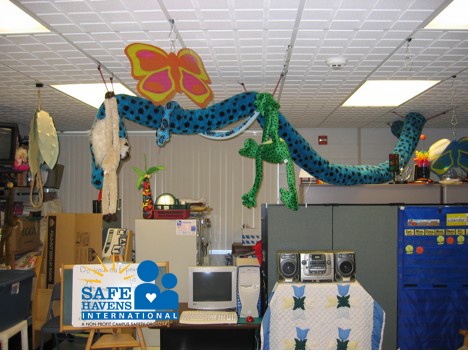
Each month we will feature a photo illustrating a hazard and how to fix it or a positive example of ways to improve your school’s safety and environment.

What’s wrong with this picture?

Fire hazard

Answer: The items hanging from the ceiling are in violation of the fire code.  If these articles were to catch fire, they might cause the flames to burn through the ceiling tiles and allow the fire to spread throughout the structure.  There is also too much clutter in the room for a safe and orderly emergency evacuation, and items are stacked in a dangerous manner, particularly since the room serves small children. While we can appreciate this teacher’s creativity in making the classroom a welcoming environment, we must always consider the safety implications of our actions.

For examples and training on how to conduct a Site Survey of your facility, check out the Tactical Site Survey Power Point slide show in our Free Resources section. While our examples are taken from schools, it is not hard to find applications for this technique in any field.

Have a photo that you think should be featured in this column? E-mail it to us and if we feature it we’ll send you a free book. Remember that both positive and negative examples are welcome.


Quick, What do we do?
A Sample Tabletop Exercise Scenario

What is a Tabletop Exercise?
A focused exercise designed to test and determine gaps in your existing crisis plan.

FEMA recommends that emergency response plans be tested using a graduated series of exercises (Orientation, Drills, Tabletop Exercise, Functional Exercise, Full Scale Exercise). To use this scenario, gather staff members from various roles (administration, teachers, office staff) in a room and give them the scenario (but not beforehand, so as to simulate the surprise of a real crisis). The team then talks through the various steps that would be taken in response to this incident. If any outside agencies would be called or involved, contact them and ensure that their response will be able to meet your expectations. During a Full Scale exercise (the last step in the testing process, which FEMA recommends 12-18 months of pre-preplanning) these outside agencies would preferably be directly involved in the exercise in real time.

Student Committing Suicide in Front of School
(High school level)

It is Monday during the first week of school, as students are arriving for the day, a male student exits his vehicle in the parking lot, goes to the trunk of his car and removes a shotgun.  While a dozen astonished students watch, he places the butt stock of the gun on the ground, inserts a long stick in the trigger guard, places the muzzle of the weapon in his mouth and steps on the stick, discharging the weapon.  The scene is gory as there is severe trauma to his head and students instantly become very upset.  By the time the first school official arrives at the site, a dozen more students have arrived and are approaching the group of distraught students who are standing around the body.

Each month we will feature a different exercise (tabletop or functional) to give you ideas for your own emergency plan testing program. For more information on testing your plans with drills and exercises, check out the free FEMA Independent Study course IS-139 or our training offerings.

News Briefs 

Atlanta, Georgia – A federal judge dismissed the lawsuit of a high school student who was suspended for 10 days after bringing to school a story she had written about a dream in which a student shoots her 6th period math teacher. The student, who also happens to take math during 6th period, was initially expelled before her sentence was reduced to 10 days of suspension. The U.S. District Judge in the case determined that the writings were “sufficiently disturbing” and supported the school’s actions. Source: CNN, Associated Press 8/3/06

Beijing, China –More than 200 primary school students were hospitalized in the most recent of 185 food poisoning cases since June. The high frequency of incidents is due to lax food preparation supervision, which allows contractors to cut costs but has resulted in thousands of cases of food poisoning this year. The latest case, which filled three floors of a local hospital, was the result of a lunch served on Friday. Students began having symptoms over the weekend including headache, fever, diarrhea and vomiting, but none of the cases were fatal. Like similar cases in the United States that we see occur every year, this illustrates the need for increased food safety and supervision, a measure that not only protects against food poisoning and contamination but against malicious acts by disgruntled students or terrorists. Source: CNN 9/03/06

Free Resources

This month we are featuring our grant resources page. This page features our Grantwriting FAQs and tips, a list of suggested grants for schools working to improve safety, as well as links to other sites with helpful information on grants and finding money for safety.

Our Grant Resources Page


All content copyright 2009 Safe Havens International. Any unauthorized reproduction is forbidden. For reprint permission contact chris@weakfish.org.


The Safety Net is a free e-newsletter designed to help you build a safety net to make your schools safety & more inviting for all students and staff members.

Each issue will feature articles, regular columns on safety hazards and drug abuse, helpful tips and free resources to aid you as an advocate for the children.For info on having your writing featured in The Safety Net please contact us. For more information about Safe Havens International (publisher of The Safety Net) click here.


Featured product of the Month:

Jane’s Safe Schools Planning Guide
for All Hazards
by Michael Dorn, Sonayia Shepherd, Greg Thomas and Marleen Wong
(2004, 450 pages)

Jane’s Safe Schools Planning Guide for All Hazards is a textbook-sized reference for school planners tasked with designing, implementing and maintaining a safe school plan.

Contents include:

– Safe school standards, roles and responsibilities

– Prevention/mitigation, preparedness, response and recovery strategy development

-Characteristics of violent youth

-Vulnerability and threat assessments for schools

-Training, education, evaluation and exercises

-Developing contact lists

-Disaster planning

-Preparing for and managing stress